
"Colorado Sober"
Why a Growing Number of Adults Are Leaving Alcohol Behind and Choosing a Different Kind of Altered State

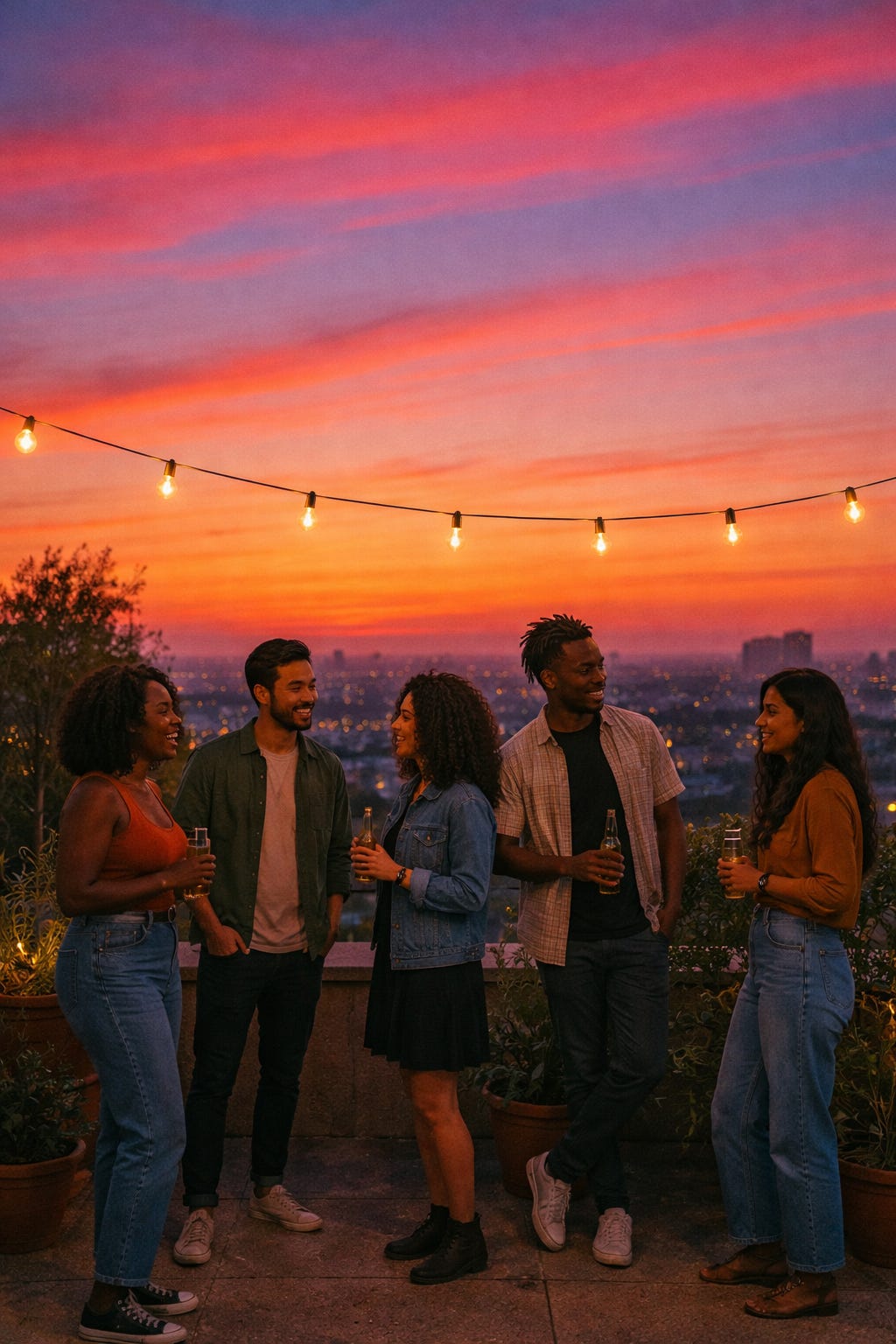
Picture this.
You’re meeting a few friends out one night, the kind of friends you’ve known long enough that there’s no real catching up anymore, just continuing where you left off. It’s a bar you’ve all been to before, not because it’s special, but because it’s familiar and no one felt like overthinking the plan.
This isn’t a transcript of a single evening so much as a composite. Based on real moments, rearranged slightly, with details changed for obvious reasons.
Everyone’s roughly in their forties. Jobs, kids, former jobs, former marriages, the usual accumulation of a life that’s been lived long enough to shed some illusions. You sit down, exchange a few hugs, order something to drink without really thinking about it.
What shows up are glasses of water.
It takes a second to register, the way absences sometimes do. Someone eventually laughs and says, almost surprised, that they guess they’re not drinking tonight, and that opens the door for the rest of it to come out naturally. A few people had split some psilocybin gummies earlier. A few others had shared a joint before heading over. Nothing dramatic, nothing hidden, just enough to soften the evening and shift the tone of the room.
What stands out isn’t the substances, it’s the ease. Everyone’s present. Conversation moves without effort. People listen without waiting for their turn to talk. No one is trying to take the edge off because there doesn’t seem to be much of an edge there to begin with. You’re sitting in a bar, surrounded by alcohol, and no one wants any.
This hypothetical scene points toward something I’ve been hearing more and more people describe as Colorado Sober.
Not abstinence in the old sense and not a moral stance, but a quiet recalibration. Colorado Sober, as I’m using it here, describes someone who chooses not to drink alcohol while still engaging with psychedelics and or cannabis, sometimes occasionally, sometimes more regularly, in ways that feel intentional rather than compulsive. It’s different from what people often call California Sober, which usually means cannabis without alcohol. Colorado Sober includes psychedelics in the mix, not as an escape hatch, but as a different relationship to altered states altogether.
At least in my world, this way of being doesn’t feel fringe anymore. It shows up casually in conversation, often without labels, often with a sense of relief, as if people are finally saying out loud something they’ve been quietly practicing for a while.
I’m in my late forties, and many of my friends are in their forties and early fifties, which seems to be an age where feedback becomes harder to ignore. There’s a sentence I hear again and again, usually spoken plainly, without drama: alcohol just doesn’t work for me anymore. The reasons vary, but the arc is familiar. Hangovers linger. Sleep gets disrupted. Anxiety creeps in. The body speaks more clearly and with less tolerance for being overridden.
I’ve slowed my own drinking over the years. I was never much of a drinker to begin with, but now it’s mostly the occasional beer, almost always social, rarely anything stronger. Not out of discipline or virtue, but out of listening. My body offered feedback, and eventually I learned to trust it.
What’s interesting is that this personal reckoning seems to be echoed, at least in part, at a cultural level. Alcohol consumption in the United States has been softening, particularly among younger adults and increasingly among people in midlife, even as psychedelic use, defined broadly, has quietly become ordinary. Roughly one in six Americans reports having used a psychedelic or hallucinogen at least once in their life, and millions report using them in the past year, numbers that place these substances firmly within everyday reality rather than the margins.
This isn’t only happening in countercultural pockets. It’s showing up in living rooms and therapy offices, at concerts and dinner tables, across cities and suburbs and small towns, and, hypothetically speaking, in bars where alcohol no longer feels like the default.
There isn’t a clean study yet that proves alcohol is declining because psychedelics are replacing it. Culture tends to move faster than data, and causation is slippery. But when you listen closely to how people describe their choices, a pattern begins to form. Many are using psychedelics in the very spaces where alcohol once lived, before shows, before social gatherings, before nights out, not to disappear from themselves but to arrive a little more fully.
Alcohol is a blunt instrument. It narrows awareness, inflames the body, disrupts sleep, and strains relationships. Psychedelics tend to ask something different. They’re physiologically gentler, non-addictive, and instead of dulling perception, they often widen it. They invite insight, perspective, and a subtle shift toward empathy, both inward and outward.
That doesn’t mean they’re toys or that they’re for everyone. Context matters. Intention matters. Legality matters. Integration matters. But it does help explain why so many people, especially as they age, seem drawn toward substances that help them remember rather than forget, that deepen connection rather than erode it.
If you return, hypothetically, to that bar on that imagined fall evening, what lingers isn’t the question of what anyone took. It’s the quality of the space. The way conversation unfolded without friction. The absence of escalation. The feeling that the night could end early without feeling cut short, not because it fell apart, but because it felt complete.
Colorado Sober isn’t a movement yet. There’s no flag, no manifesto, no merch table. It lives quietly, in small choices and subtle shifts, in moments like this imagined one, where old habits loosen their grip and something more attentive takes their place.
Even as a composite, even as a thought experiment, it points toward a generation learning, slowly and imperfectly, how to choose medicines that ask us to pay attention instead of check out.
And that, hypothetical or not, feels like a story worth telling.
As someone who’s recently embraced the Colorado sober life, thank you for writing this!